The Tefillin in Quarantine: Seeing the Dancing Letters
A halachic question was posed to a leading rabbinic authority on medical ethics and Jewish law. In the early 1980s, a patient was quarantined in Hadas
Torah, Chassidus, and the stuff of everyday life: written, taught, and shared from the North Shore.

A halachic question was posed to a leading rabbinic authority on medical ethics and Jewish law. In the early 1980s, a patient was quarantined in Hadas
This weeks Torah portion Lech Lecha, "showed up" —moving in for the week to inhabit the collective Jewish imagination, for its tenured annual slot in
How do you free a hostage who doesn't know they're a captive?
Week 3 of the live Thursday-evening Opening the Tanya class, continuing the journey through the Alter Rebbe’s Tanya and its practical wisdom for the inner life of the soul.
A concise summary of Week 1 of Opening the Tanya, introducing the Alter Rebbe’s foundational approach to the inner life of the soul.
Massachusetts Governor Charlie Baker, a Swampscott neighbor, joins Rabbi Yossi and Layah Lipsker at Chabad of the North Shore to kindle the Chanukah menorah and dance a joyous Hora in front of the ornate wooden Aron Kodesh accompanied by a live Klezmer band.

For decades, the Jewish Journal (jewishjournal.org) has chronicled Rabbi Yossi Lipsker’s leadership on the North Shore—from cover profiles (Honorable Menschion, Chabad’s Yossi Lipsker is a Rabbipreneur, 50 Rabbis in Houston) to his regular columns on Chassidic wisdom and contemporary Jewish life.
Before a packed auditorium of 460 people at Higgins Middle School in Peabody on the eve of the third anniversary of October 7, former Israeli hostage Omer Shem Tov shared the story of his 505 days in Hamas captivity in Gaza, followed by an emotional onstage Q&A moderated by Rabbi Yossi Lipsker.
“You changed me, my life, tonight, in more ways than I can begin to describe to you, and I suspect that no one will leave this room without feeling the depth of the courageous story you shared.”
PEABODY — When you meet Omer Shem Tov, you notice the 24-year-old former Israeli hostage has a small smiley face tattoo just under his ear. Snatched by terrorists at age 20 during the attack on the Nova music festival in southern Israel on the morning of Oct. 7, 2023, he marked two birthdays during his 505 days in captivity.
On Oct. 6, Shem Tov spoke to a packed Higgins Middle School auditorium of 460 people on the eve of the third anniversary of the attacks. During the event, titled “Resilience,” the audience stood several times to applaud him.
“More than anything, I’m trying to spread love and trying to spread light,” Shem Tov said. “I want people, Jews and non-Jews, to understand that it doesn’t matter what you are going through. You can go through dark times. You can cry about things. But there’s always, always at the end of the tunnel, there is light. And for someone who was in a tunnel for 450 days, I can tell you there is light at the end of the tunnel.”
Shem Tov’s talk alternated between tales of abuse at the hands of his captors and moments of levity, faith and small miracles that kept him alive. At night he would speak with God. Instead of asking God for something like a fancy house, he would say “Father, how are you? How is your day today? Are you OK?” He would thank Him for the piece of bread or dirty water he got.
He spoke about being released on Feb. 22, 2025, alongside fellow former hostages Eliya Cohen and Omer Wenkert. The hostages were told to dress in IDF uniforms and were escorted to the entrance of a tunnel. In front, Shem Tov heard Cohen whisper Shir LaMa’alot, Psalm 121, the Song of Ascents. Shem Tov started singing this prayer for the audience. The three sang this as they exited the tunnel.
Shem Tov’s talk was sponsored by Chabad of Peabody, Peabody Public Schools, the Jewish Journal, the North Suburban Jewish Community Center and Combined Jewish Philanthropies.
Chabad of Peabody Rabbi Nechemia Schusterman said he has long followed Shem Tov’s story since he started praying for his release during a prayer circle shortly after the Oct. 7 attacks. He wanted to spread Shem Tov’s story beyond the Jewish community, noting that one-third of the audience was not Jewish. “I want tonight to be about something bigger, an evening dedicated to eradicating all forms of prejudice and hate and I hope you will join me in that,” the rabbi said.
Chabad of the North Shore’s Rabbi Yossi Lipsker, who moderated a question-and-answer session after Shem Tov spoke, gave him a hug onstage.
“You changed me, my life, tonight,” Lipsker said, “in more ways than I can begin to describe to you and I suspect that no one will leave this room without feeling the depth of the courageous story you shared.”
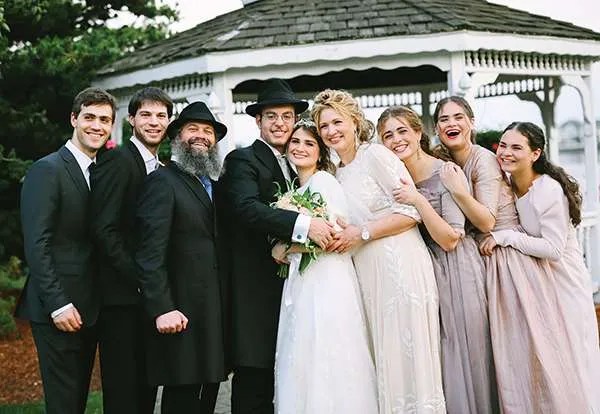
A full-length Q&A profile tracing Rabbi Yossi Lipsker’s childhood in Philadelphia, his rabbinic studies in London, Boston, and Brooklyn, his arrival on the North Shore in 1992, the growth of Chabad centers across Swampscott, Peabody, Lynn, and Everett, and the spiritual power of Chassidic melody.
“I feel like the North Shore is so much deeper than the beautiful place to live that it is. I see it as a place that has been etched into my soul and become part of my spiritual DNA.”
Rabbi Yossi Lipsker opened Chabad of the North Shore in 1992 in Swampscott and since then has expanded to Peabody, Lynn and Everett. Lipsker is the son of a Chabad rabbi, and grew up in Pennsylvania. He attended Yeshiva High School in Pittsburgh, followed by two years of study in London and Boston – and also did internships in California, Nebraska, England and Belarus.
He received his rabbinic ordination in the Central Lubavitch Yeshiva in Crown Heights, in Brooklyn. He is married to Layah Lipsker, and their children are Yaakov, Eliyahu, Adina (and her husband Moishe Wilhelm), Sheva, Batya, and Michali.
Q: Can you tell me about your upbringing, where you grew up and your family background? — I grew up in Northeast Philadelphia. My parents are shluchim of the Lubavitcher Rebbe and this was an integral part of my upbringing. I always knew intuitively that this was my path. Though my folks are in their late seventies and early eighties, they have lived and worked there for close to 60 years.
My dad has never formally retired and is still an active rabbi and teacher. Our home was an open door to roving charity collectors, and a home away from home for an entire cast of down-on-their-luck Vietnam veterans, Holocaust survivors, Russian emigres, and many homesick Israelis.
They all found an open door, a warm meal, and a listening ear.
Q: You were a yeshiva student in Boston when you fell in love with the North Shore – can you tell us about that? — It feels like there was a lot of synchronicity at work “behind the scenes” – seemingly random events conspiring, to bring us together with the North Shore. In the early 1990s, Mendel Kaufman helped run a tiny synagogue out of Harry Fielding’s living room on Seaview Avenue in Marblehead.
He had learned of the arrival of the new rabbinical students and was looking for two volunteers to come to run services, teach classes, and do some holiday programs. As soon as he saw Mendy Feller and me, his face lit up with joy. The rest is history. We went there every single Shabbat for two years.
I knew then that this was where I needed to be. As a result, I feel like the North Shore is so much deeper than the beautiful place to live that it is. I see it as a place that has been etched into my soul and become part of my spiritual DNA.
Q: When you arrived in Swampscott in 1992, you knew few people in the area. Why were you confident that people would embrace Chabad? — I think our approach was unique in the way it was very geared to fostering personal relationships and that was something of an anomaly in the community at the time.
It seemed to resonate. We opened a Hebrew School that was fun and upbeat way before its time. It was amazing for parents to hear their children nudging them to “hurry up or we’ll be late for Hebrew school.” We came with the Hasidic warmth, and mystical joy that was central to our religious upbringing and the optimistic non-judgmental vision of the Rebbe.
Q: How do you explain your growth and popularity, and the support you’ve received? — I attribute any success we have had to numerous factors. The commitment and dedication of my wife Layah for agreeing to move here with me was instrumental in the founding and growth of the organization.
The love and support and pride of our children was a huge factor. The looming and very much larger-than-life spiritual presence of the Rebbe grows even more inspirational. And none of this would have been possible without the extraordinary generosity of our tzedakah partners. We never saw this as fundraising per se, more like a sacred partnership geared toward the betterment and continuity of Klal Yisroel.
Q: As a rabbi, what are the biggest challenges you’ve had to face this year of COVID-19, and how have you dealt with them? — Overall, despite the hardships – and there were many – I realize that I have come out of this with a “more real” level of gratitude. A lot of people struggled with a fear of dying and that hit very close to home.
For me, that was exacerbated by the high volume of burials I had to perform. I guess it’s positive in the ways it pushes us to focus on unfinished business which in truth is every second of life. I continue to share a message of hopefulness and positivity. I believe that the fact that we’re still here is G-d’s way of letting us know that the universe requires our presence.
Q: Is there one Hasidic principle that motivates you each day? — Tracht Gut Vet Zayn Gut! Think positive and it will all come together in the end! (Obviously it won’t happen without putting in the hard work as well!)
Q: You love to sing and pray. What is the importance of prayer and song and how does that nourish the soul? — When I sing, especially during prayer – but it could be when I’m driving as well – I release whatever it is that might be holding me down, and I am suddenly free, and lost in the song.
During these moments, the song itself becomes an act of prayer as well. Additionally, Hasidic melodies are very grounding for me and serve as an anchor and reminder of my purpose that can’t be achieved solely through study and meditation.
Q: When you’re not in synagogue how do you like to best spend your time? — I love riding my motorcycle around the North Shore and enjoying the smell and sight of the ocean. If I have a moment to myself, I will steal away to a used bookstore and get lost there. I love to read but do most of that on Shabbat evening and afternoon.
WCVB NewsCenter 5 reporter David Bienick interviews Rabbi Yossi Lipsker following the terror shooting at a first-night Hanukkah celebration in Sydney, Australia, where Rabbi Lipsker’s former study partner from London, Rabbi Eli Schlanger, was murdered and a cousin’s 20-year-old son was wounded. Rabbi Lipsker describes how North Shore Hanukkah lightings took on a spirit of resilience and defiance.
“My twin sister was comforting his sister in New York at 4 a.m. in her home. So the connections are all around and quite, quite strong.”
Rabbi Yossi Lipsker from Chabad of the North Shore said he knows two of the people who were shot on a beach in Sydney this past weekend.
One is the 20-year-old son of a cousin from Texas who was shot in the abdomen but survived.
The other is a fellow rabbi named Eli Schlanger, whom Lipsker knew as a child while studying in London.
Schlanger was among the 15 people killed during the massacre on Sunday.
"My twin sister was comforting his [the victim's] sister in New York at 4 a.m. in her home," Lipsker said. "So the connections are all around and quite, quite strong."
Rabbi Lipsker said this year's local Hanukkah ceremonies have taken on a note of resilience and defiance following the attack.
He said they are attracting large numbers of people, including some newcomers.
Tuesday marked the third night of Hanukkah.
Australian authorities said the father and son who carried out the mass shooting were inspired by ISIS.
The father was killed, and the son remains hospitalized.
The Boston Globe features Rabbi Yossi Lipsker and Chabad of the North Shore coordinating public Hanukkah menorah lightings across more than a dozen cities and towns from Everett and Revere to Swampscott and Salem, marking 30 years since his first public menorah lighting at the Northshore Mall.
“The light illuminates the positives in a time of particular darkness marked by bigotry and hatred… It was the first public menorah lighting we ever did 30 years ago. It is important to share the universal symbol of light and Jewish pride.”
In the literal sense, candlelight brightens the long, dark, December nights. For Rabbi Yossi Lipsker, regional directorof Chabad of the North Shore , Hanukkah is also symbolic as “The light illuminates the positives in a time of particular darkness marked by bigotry and hatred.”
The Anti-Defamation League New England , a civil rights agency, recorded a total of 108 antisemitic incidents in Massachusetts last year, a 48 percent increase from 2020 . Vandalism incidents increased by 66 percent.
“Our work tends to focus on the increasing number of incidents of antisemitism in New England and the lasting harm these incidents inflict on a community,” said Peggy Shukur, interim ADL New England deputy regional director. “The holiday of Hanukkah is a much-needed reminder to take pride in expressing our religion openly and without fear as we reflect on and celebrate the strength and resilience of the Jewish community.”
Rabbi Fred Benjamin of Congregation Beth Shalom of the Blue Hills in Milton stressed that Hanukkah is “about religious freedom and overcoming oppression.”
Hanukkah brings Jewish people together to share the light of the menorah candles in remembrance of a miracle more than 1,800 years ago when a group of Jews, despite being outnumbered, defeated a Greek army and reclaimed the temple in Jerusalem. There was only enough purified oil to relight the temple’s menorah for one night, but it lasted for eight nights — thus the miracle.
“The mitzvah [a good deed done from religious duty] of Hanukkah is to put the celebration out into the world,” explained Benjamin. “Traditionally, you put the menorah in the front window of your house facing the street. It is an expression of religious freedom,” said Benjamin, who will preside over the celebration in the community during the city’s annual public menorah lighting at 5 p.m. Dec. 18 on the Hancock Adams Common in Quincy.
The menorah lighting is such a longstanding tradition that Quincy Mayor Thomas Koch can’t even remember when it began. Donated years ago, the electric menorah is set up annually by the Department of Public Works.
“We have been lighting a menorah on the Common for at least the 15 years since I have been in office,” said Koch. “Quincy is a very diverse community and the menorah lighting is just one part of the many events we celebrate during the holiday season. It is important to recognize the holiday season with our Jewish residents.”
Koch expects no antisemitic incidents related to the Quincy menorah lightning, but his office does work with the police department to prepare for public safety during such events.
“Unfortunately, every public event — from our holiday tree and menorah lighting to the Christmas parade — requires preplanning, including restricting parking and setting up road barriers,” said Koch.
Focused on the importance of sharing the holiday with others, Rabbi Jodi Seewald Smith, director of congregational engagement at Temple Isaiah in Lexington, invites everyone to attend its Hanukkah 2022 Hygge Festival Dec 18 from 3:30 to 5:30 p.m. It will include outdoor lights and projections, fire pits, s’mores, and Hanukkah music. The festival celebrates the holiday and also “life’s simple pleasures, friends, family, graciousness” according to the temple’s website, templeisaiah.net .
“We actually debated whether to keep the event within the congregation or did we want to be open and welcoming,” said Seewald Smith. “We decided to be welcoming and extended the invitation to anyone that wants to come. Participants are encouraged to bring a [menorah] and candles.”
Balancing openness and safety, Temple Isaiah has had security in place for events for several years, according to Seewald Smith.
“It is just a standard precaution. We have full and robust programming and we decided we are not stopping because of worry about external factors,” she said. “Even with antisemitism, we live in a country that protects our religious freedoms. The Hanukkah festival is very much a multigenerational event and we are expecting hundreds of people.”
The Chabad of the North Shore, which serves 22 communities, is coordinating community menorah lightings in a dozen cities and towns from Everett and Revere to Swampscott and Salem. The Chabad owns, stores, loans, and delivers the large electric menorahs to participating municipalities and shopping centers.
Public Hanukkah menorah lightings are important to Lipsker, the Chabad’s rabbi, as “they showcase the beautiful diversity of religious views, faiths, and traditions. Standing shoulder to shoulder, the public celebration shows us at our best.”
One of Lipsker’s favorite events is the menorah lighting at the Northshore Mall in Peabody , which will be held from 4:30 to 5:30 p.m. Dec. 21.
“It was the first public menorah lighting we ever did 30 years ago,” said Lipsker. “It is important to share the universal symbol of light and Jewish pride among the cultural holiday decorations at the mall.”
Despite Lipsker’s positive attitude, the ADL reports that over the past few years, there has been vandalism to outdoor menorahs. A large menorah was vandalized and stolen from a Brookline temple in 2018 .
In Quincy, Rabbi Benjamin will share “songs and a few surprises which might include chocolate gelt [coins] and dreidels [spinning tops]” with the families that attend the outdoor menorah lighting.
“The celebration of light is a celebration of the diversity of views, faiths, and traditions,” he said. “Every menorah lighting is a little slice of utopia.”
Linda Greenstein can be reached at greensteinlm@gmail.com .
In an in-depth Haaretz Weekend Magazine report from the International Conference of Chabad-Lubavitch Emissaries (Kinus Hashluchim) in New York, correspondent Yair Ettinger interviews Rabbi Yossi Lipsker of Swampscott, Massachusetts on self-expression within halakha and the unconditionally welcoming ethos of a Chabad House.
“We will never do anything that departs from the halakha, but each emissary also has a lot of room for self-expression… We do not judge anyone for his acts and his opinions; we do not look down on others. We are part of the community and its needs. The role of a Chabad House is to create a community, mutual surety and true friendship; to forge a place where there is creativity.”
How did a small Hasidic court become a phenomenon that is fomenting something of a revolution in the Jewish world? The 4,000 Chabad emissaries who convened in New York offer a simple answer: energy, motivation, love and tolerance.
NEW YORK — Inspector Charles Scholl scurried back and forth, barking orders and keeping a close eye on the preparations. The veteran Brooklyn South officer, a kind of local sheriff in the Crown Heights neighborhood, did not let the euphoria around him on this bitterly cold November morning distract him from the weight of his annual fall task: to make it possible for a huge number of Hasidim to gather for a group portrait against the backdrop of a certain brick building on the main avenue.
The traditional photo of the Hasidim in front of the building at 770 Eastern Parkway, where the Lubavitcher Rebbe lived until his death in 1994, is one of the high points of the annual International Conference of Chabad-Lubavitch Emissaries, which was held last month in New York. It’s a manifestation of the strength of the Hasidic movement, which in recent years has become a global force, exercising dramatic influence on the Jewish world – mainly outside Israel – with bases in 76 countries and some 4,000 shluchim – literally “sent ones,” or “emissaries” – not counting the families that accompany them.
According to the documentation stored in the computer of Chabad’s Brooklyn-based Merkos L’Inyonei Chinuch – the movement’s educational arm, which is in charge of the worldwide network of emissaries – every two or three days on average, another Hasid leaves for another part of the world on a one-way ticket. He may open a new center or join an already existing one.
“Many Hasidim want to be emissaries these days, and our problem is to find new places for them,” says Rabbi Moshe Kotlarsky, vice chairman of the educational center and the dominant figure in the management of the global network.
One reason Chabad has become stronger in the United States, says Prof. Chaim Waxman, a senior fellow of the Van Leer Jerusalem Institute whose specialty is the sociology of religion with an emphasis on American Jewry, is the diminishing importance of the Jewish establishment in the self-definition of Jews.
“People are no longer looking for affiliation with one of the streams of Judaism, and they are finding that it’s easiest with Chabad,” he says. “You don’t have to connect with any stream or any synagogue. You can come and take what you want from the experience and that is it. People like it that there are no hard and fast rules, that there is communication with other streams.
Chabad has sincerity, and people recognize that.”
But doesn’t Chabad also have a hidden agenda? Emissaries I spoke with in Crown Heights, all of whom are active in the United States, were amazed at the question. “We have no hidden agenda, and therein lies the strength of Chabad, especially in the United States,” said one emissary. “We have no conspiracy beyond helping every Jew everywhere, unconditionally. We aspire to bring every Jew a degree closer to the Torah and to the Holy One than he is today, and that includes people who are defined as religious.”
Rabbi Yossi Lipsker, who founded Chabad House in Swampscott, Massachusetts 19 years ago, intervenes in the conversation. “We will never do anything that departs from the halakha, but each emissary also has a lot of room for self-expression,” he says, thereby also explaining his unusual exterior appearance, which adds to the Chabad look relatively long hair that is mostly hidden by a wool skullcap, along with fashionable spectacles.
He describes the emissary’s role in Hasidic-hippie terms of “plying people with love, giving them hope. We do not judge anyone for his acts and his opinions; we do not look down on others. We are part of the community and its needs. The role of a Chabad House is to create a community, mutual surety and true friendship; to forge a place where there is creativity.”
The five days of the conference concluded with the “Gala Banquet” event held at the Brooklyn Cruise Terminal at Pier 12. The organizers of this glittering and gargantuan event went all the way to Brooklyn’s Red Hook section because that was the only place they could find with a large enough space to accommodate the 350 tables and 4,700 guests.
The New York Times declared the event the largest sit-down dinner in the history of the city and was awed by the numbers: 90 chefs, 340 waiters, 15,000 glasses, 182,000 square meters of a spectacularly beautiful structure, with a view of the Statue of Liberty.
Toward the end of the evening, Rabbi Kotlarsky from the Merkos L’Inyonei Chinuch read out a “roll call” of all 76 countries in which Chabad is represented and invited the emissaries from each country to stand up, to the applause of the audience. “Let’s go on a trip around the world,” Kotlarsky said, and started to read the list of countries – from Asia via Australia and then to Africa, Europe and the Americas.
Like the traditional group photo, this too is one of the non-spontaneous highlights of the Kinus of emissaries, planned to the last detail. But it was shattered by an outburst of authentic Hasidic joy when, at the conclusion of the list, 4,700 people got up and started to dance to the music of an old Chabad melody, like a winding snake, a great chain of people, all dressed in black, representing every corner of the globe.
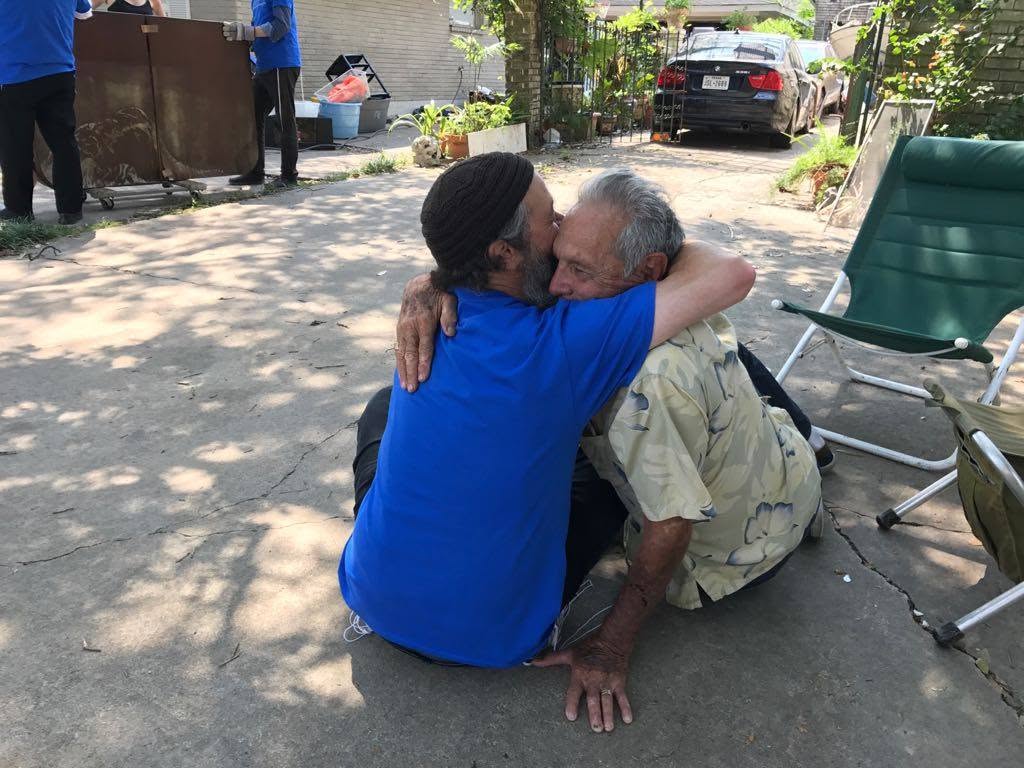
When Hurricane Harvey inundated Houston over Labor Day weekend, 1Mitzvah co-founders Nate Dalton and Rabbi Yossi Lipsker mobilized 50 Chabad rabbis from across the country within 24 hours—along with a multi-state ‘Convoy of Hope’ of supply trucks from Connecticut, Michigan, Tennessee, and Georgia—to spend 48 hours gutting flooded homes, serving Red Cross meals, and comforting survivors.
“He told me he had never fully recovered from losing his wife, and that she was everything to him, and the house reminded him of her, and he felt like he was losing her again. I was sitting on the ground and he came close to me and burst out crying… And then he said, ‘thank you for being here, and for comforting me.’”
SEPTEMBER 14, 2017 – It was Labor Day weekend and Hurricane Harvey was pounding Houston and southern Texas and Nate Dalton decided to pick up the phone and call Rabbi Yossi Lipsker in Swampscott. “What are we going to do about Houston?” Dalton asked.
Lipsker knew exactly what his friend was asking about. Dalton, a philanthropist and former Marblehead resident, had teamed up with Lipsker three times last year to provide hurricane relief for residents of hard hit communities in Savannah, Baton Rouge, and New Orleans. The two created 1Mitzvah, a nonprofit dedicated to spreading the awareness of the power of performing one good deed.
“I realized I was going to go, and I said to myself if I can reach this conclusion, let me find 49 other rabbis around the country that will do this,” Lipsker said. He convinced his brothers-in-law in Virginia, Yossel Kranz and Sholom Deitsch to go, and then they created a WhatsApp group. Phone calls started to come in from all over the country, and within a day, 50 rabbis were set to convene in Houston, where they would spend 48 hours assisting Red Cross and emergency workers, and Chabad in Houston.
Meanwhile, right before Labor Day, Lipsker coordinated a convoy of relief trucks stuffed with food supplies that headed to Houston from Connecticut, Michigan, Tennessee and Georgia. By the time the 50 rabbis arrived last Tuesday, the supplies in the trucks were waiting to be emptied and distributed by the rabbis.
In Houston, the rabbis were dispatched to homes around the entire city to meet with Jews and non-Jews who were impacted by the hurricane. The rabbis entered waterlogged homes, and helped people carry their personal items out to the street. While some rabbis helped tear down walls to rid the homes of mold, others were sent to shelters where they spent hours talking with people who needed a shoulder to cry on.
“There was an enormous shortage of qualified pastoral personnel and we filled a huge void,” Lipsker explained.
On one of his trips to help clean out homes, Lipsker encountered a man who explained that the house that he had built with his wife was in ruins. “He told me he had never fully recovered from losing his wife, and that she was everything to him, and the house reminded him of her, and he felt like he was losing her again,” said Lipsker.
“I was sitting on the ground and he came close to me and burst out crying. A river of tears opened up. He grabbed onto me and wouldn’t let me go and held me. And then he said, ‘thank you for being here, and for comforting me.’”
Lipsker and the rabbis also hopped aboard Red Cross trucks and handed out thousands of meals to locals. “I found myself thinking about the paradox of an Orthodox rabbi feeding ham and turkey to non-Jews, but it felt right,” he said.
Synagogues, schools, civic gatherings, and conferences. Talks on the Rebbe, Chassidic wisdom for daily life, the Jewish year, and more.
Follow along wherever you like to read and watch.
You can also follow on YouTube, Facebook, X (Twitter), and Medium.